Steelworker and labor advocate Ike Gittlin takes a sobering look at today’s retirement with On Working Till We Drop…
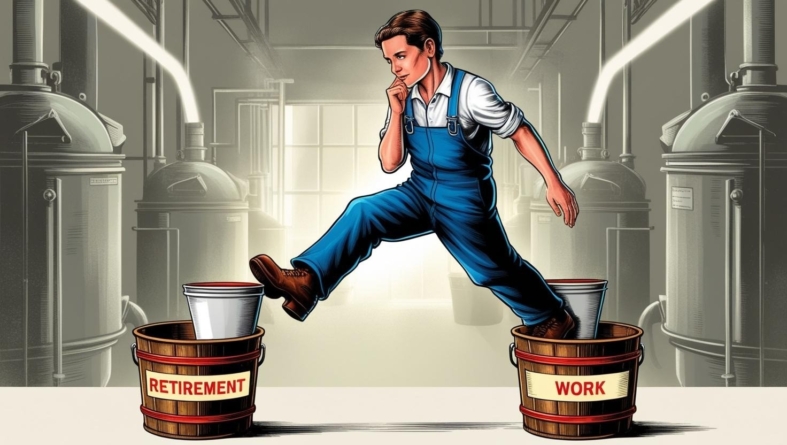
On Working Til We Drop: I was talking to one of the Steelworkers impacted by the USSteel/Nippon deal the other day. He had 15 years in and said “I just want to make it to retirement”. Another person, who heard that, later said “me too”. Both are “trapped” workers. They have too much time in their current employment to voluntarily leave, but a ways to go to get reach retirement eligibility. Their hopes for a secure retirement are up against strong headwinds. If we look at what’s been happening to people who work for wages, the very concept of retirement has been under attack for a couple of decades.
I remember 25 years ago, being in a meeting with the Pennsylvania Secretary of Aging. He was an extraordinary public servant and a fierce advocate for seniors. He was briefing us on a new State program that helped seniors get “post-retirement” jobs at places like Wal-Mart and Home Depot. This was in response to a growing crisis of retirees not having enough money to meet their basic needs. Everyone complimented him on the new program. I did as well, with one observation. Wasn’t there something really wrong, that people who have put in a lifetime of work, can’t enjoy their final years without working? What’s our program for that? The room sobered up. That’s still my question today.
Retirement security, in today’s world, means some kind of retirement plan, social security personal savings and decent healthcare coverage. The $1,000/month “rule” advises that for every $1,000 of monthly retirement income you want, you need approximately $240,000 in savings. This means, for example, if you want $4,000 per month, you’d need close to a million dollars in savings. We reduce that amount with any pension earnings and Social Security income, but it still is a startling number. (US Dept of Labor).
A piece of retirement security is tied to what kind of pension plan is available to workers. Corporations used to form the base of a blue-collar workers retirement security. Today, the most secure “defined benefit” plans, that assure a stated monthly benefit, are now only available to 15% of the workforce. They have been replaced by plans, that pay out in accordance investment earnings from premiums paid in. A 401k, which is touted as a retirement plan, isn’t one. It’s a tax deferred savings plan, and is subject to the volatility of the financial markets. Going back to that $1,000/month rule, you can see that the move away from defined benefit pensions has made working Americans much less likely to achieve retirement security.
As a result of corporate America’s abdication of its role in retirement security, more pressure has been put on Social Security. “In 2022, Social Security made up at least half of total personal income for 63.2% of adult recipients, according to the SIPP data. For 43.6% of recipients, it accounted for three-quarters of their income. For 27%, it was their only source of income”. (Social Security Administration). 10.2% of Americans over 65 year of age live in poverty (KFF). Social Security was never designed to be our only retirement income.
Our political leaders keep moving the goalposts on Social Security. As current lawmakers seek to cash out programs that help workers, to further enhance the already wealthy, confidence in Social Security’s commitments continues to dwindle.
On the healthcare front, only about 40% of retired Americans have insurance beyond Medicare. This number has been dropping, indicating that more retirees are totally dependent on Medicare. Here too, current lawmakers are in a hot debate about reducing the nation’s commitment to senior healthcare security, using various gambits to hide their defunding efforts.
The pressure on retirees shows in the statistics. 13% of retired seniors say they’re likely to start working again next year, Top reason for retirees returning to work is increased cost of living. 22% of seniors are currently working. 4 in 10 working seniors were once retired. (Resume Builder)
In short, workers are increasingly faced with the reality that we can no longer look forward to a “non-working” retirement. This in the wealthiest nation on earth. This at the same time as we are on the cusp of handing trillions over to the wealthiest amongst us. This at a time where income inequality now rivals the Gilded Age and most workers income has been lagging for a decade and a half. That means we’re less able to make up for the old ways of gaining retirement security, by increasing personal savings.
We need to do a national review of the current state of retirement security and put in place policy that will not only shore up what exists, but solidifies into the future. There are lots of ideas of how to do that. Raising the earnings cap on Social Security needs to happen. We should be seeking to improve Social Security benefits, not lessen them. We could add a “supplemental” Social Security option where companies could pay into an enhanced benefit for workers that is guaranteed. In this way, as workers move from employer to employer, their pension earnings would be “portable”, not lost. While we worship corporate “freedom” we’re letting very wealthy entities escape from any retirement security obligation. We could change that. In the bigger picture, setting a living wage minimum for workers would allow them to have some extra income to put away more into retirement savings. Supporting unionization is our most successful economic up-lifter, and should be strengthened. Raise the Wage!
Senior healthcare needs that same review and problem solving. Here too, corporate support for healthcare has dramatically dropped. Medicare, Medicaid and the Affordable Care Act have made a major dent in our uninsured population. Instead of trying to destroy the progress that’s been made, we need to make a commitment to some form of healthcare for all.
Every retirement counselor will tell us that retirement security is best built over a lifetime. Since young people rarely put retirement savings as a priority in their early working years, it becomes a larger burden to address when they start to face their senior years. The government has a role to play in helping and encouraging people to start building that retirement security early and consistently. The money is there, if we prioritize people over outrageous profit. Unless we recognize this as a top line issue, and take up the fight now, America will again be a nation where most of us work until we drop.
If you like these commentaries, join my blog for free at:Ike’s Work in ProgressWorking Families, Union Activism and the World Around UsBy Ike Gittlen