The UAW International Executive Board elections continue until October 5. You have until then to return your ballot and this seems like a great time to Make the Case For $625 Strike Pay. For over a year I have been writing and making videos supporting the idea that raising strike pay is about more than dollars, it makes good sense.
The Case for a $625 UAW Weekly Strike Benefit
Darin Gilley
September 16, 2026
Strike Pay can make the difference between members being financially secure enough to fight for what they deserve or just giving up in order to get back to work and earn a paycheck. A reasonable weekly benefit is a key advantage the UAW can provide members that are on the front lines of a labor dispute.
Over a year ago I began trying to figure out what strike pay benefit would provide an adequate amount to members on strike while also keeping the Strike and Defense Fund sustainable and strong. The following articles and videos make the case for my conclusion that a $625 Weekly Strike Benefit accomplishes both goals. As outlined in these pieces both history and math confirm this assessment. If you are interested in this issue, please enjoy and share with your Delegates to the Constitutional Convention.
VIDEO
The first video UAW Strike Pay Should Be $625
The second video is an animated InstaDoodle, UAW Strike Pay Should be $625 in 2028!
The third video: How Much Did Strikes Cost You? Higher Strike Pay Will Help!
The Fourth Video, OMG! Can The UAW Afford $625 Strike Pay?
Articles
Strike Pay Should Be $625
Darin Gilley
UAW Local 2250
You cannot win a war on an empty stomach.
The increase in strike pay from $275 to $500 in 2023 has helped thousands of UAW members. Big locals, small locals, and everyone in-between that was eligible for strike benefits had had a little more help as they fought for economic justice. It has made the union stronger and provided much needed support for those in the heat of a contract dispute.
Those are the reasons I wrote the resolution to raise strike pay to $500.
During the 2019 UAW/GM strike I was the Financial Secretary of UAW Local 2250 which represents the four thousand members working at the GM Wentzville Assembly Center. The first couple weeks of that strike were positive. The break from a grueling schedule, the fellowship at the hall and on the picket lines made for an exciting time.
Unfortunately, by the third week I started getting calls from members that were experiencing financial distress. The food bank and donations from the community to members were not enough to meet the need as these calls increased while the strike continued. By the fortieth and last day of the strike many members were telling me they were ready to support any agreement and get back to work. The $250 strike pay for the first three weeks of the strike was not enough. After three weeks the IUAW increased the weekly benefit to $275 which was a nice gesture but not enough to make a real difference.
This is when it became obvious how the old military saying “you can’t win a war with a hungry army” come to be. When applied to a labor dispute, the quote is just as true. If members can’t feed themselves and take care of their families, it is impossible to honor the old labor motto of “one day longer.” You cannot win a strike with hungry members.
What would make a difference?
Money!
This is not that complicated. For members to last “one day longer” they needed more money while on strike. Food banks, donations, payment extensions, and all the other forms of support are helpful but the most important way to keep members strong is to use the strike fund to fulfill its mission. To keep members financially stable and not be starved into a substandard agreement.
$500 – are you kidding?
After the strike, I reviewed the numbers to determine if there was a level of strike pay that would help members on strike while keeping the strike fund strong. Below is the process used to arrive at the $500 weekly benefit.
First, what was the effect on the strike fund? The 2019 UAW/GM strike was the longest against a Big 3 automaker in decades. Was the strike fund bankrupt? Hardly. In August 2019, the International Strike Fund had a balance of $799 million. In December 2019 – two months after the strike and time for locals to request reimbursement for strike expenses, the fund had a balance of $739 million. A 40-day strike involving over 45,000 members reduced the fund by only $60 million. The fund was in no danger. In fact, at that rate the fund would have covered a year-long strike and still had a balance of over $250 million!
The strike fund could clearly afford a better weekly benefit for the members that built the fund. What weekly benefit would be enough to really help members on strike while maintaining the integrity of the strike fund? What percentage of weekly pay would be sufficient?
In 2019, top production pay at GM was $28.00 per hour which equates to $1,120 per week. Strike pay was $275 per week. That was 24% of regular pay. No wonder it was stressful.
In 2023, top production pay was $32.32 per hour which equates to $1,292.80 per week. Strike pay was $500 per week. That was 38.6% of regular weekly pay. While still challenging, the financial stress for most members was reduced.
How did the strike fund handle the increase to $500 per week? In August 2023 (before the strike) the balance of the strike fund was $847 million. In December 2023 (two months after the strike) the balance was $727 million. The impact of $120 million is substantial but a reasonable return of members’ investment of dues dollars and is no danger to the strike fund. In fact, IUAW Secretary/Treasurer Margaret Mock wrote in her report to the 2025 Financial Officers Conference that “the Strike and Defense Fund has rebounded following the 2023 Big 3 strike, growing more than $45 million to $773 million by the end of 2024.”
In 2028, top production pay will be $41.17 per hour. That equates to $1,646.80 per week. Using the current 38% the weekly strike benefit would be $625.
Key points…
Members monthly dues to the strike fund have increased with each pay raise during the contract. Members should see an equivalent return on their investment.
The strike fund has continued to grow with benefits at the 38% level. The strike fund has increased from $727 million in December 2023 to $773 million in December 2024. Update as of April 2026: The Strike Fund Balance is $838 million.
One objection raised in the debate prior to increasing the strike fund benefit was that non – Big 3 locals would be making so much money from the strike benefit that they would not ratify a new contract. This has not happened. There have been several strikes by non-Big 3 locals that have been resolved. One thing that has happened is the members of those locals have had much better financial stability during their efforts to win a fair contract.
A $625 strike pay benefit will help members with morale and financial stability during a prolonged strike. It will also allow the strike fund to fulfill its purpose for all members through sustainable payouts that are a reasonable return on their due’s investment.
I will be submitting a resolution to raise strike pay to $625 a week starting on day one. Of course, all members are invited to review the numbers and write their own resolutions.
What Did the Strikes Cost You? Higher Strike Pay Would Help.
Darin Gilley
UAW Local 2250
March 2026
UAW Local 2250 was one of the original Stand-Up Strike locals. That strike lasted 46 days in 2023. Before that, we walked the picket line for 40 days during the UAW/GM strike of 2019. Both strikes showcased the organizational skill of the leadership and the strength and dedication of the membership. Unfortunately, they also placed a financial burden on members that stepped forward and took on these fights.
This article will look at that sacrifice and offer a way to make it better for UAW members who take on the fight for themselves and others.
In 2019, the UAW/GM strike cost members forty days wages. Let’s run some numbers using the base production pay of a Traditional member.
Traditional member wage: $28.00 per hour.
# of hours per day: 8
Lost Wages per day: $224.00 per day
Multiply # of strike days: 40
Lost Wages During Strike: $8,960.00
Of course, the UAW Strike Fund was created to support members financially during strikes and made payments to members starting on day 8 of the strike. The first three weeks of the strike members received $250 a week for a total of $750. By this point, this strike was the longest GM had suffered in decades. It was also causing members to suffer and the IUAW got the message. They responded by raising weekly strike benefits to $275 a week.
Thanks to this change members received $825 over the last three weeks of the strike. This brought the total strike pay received to $1,575.00.
So how much did members lose because of the 2019 strike?
Lost Wages During 2019 Strike: $8,960.00
Minus Strike Benefits: $1,575.00
Actual Lost Income: $7,385.00
In 2023, the Stand-Up Strike resulted in some locals not having to strike at all, some for a few days, and others like those in Toledo, Wayne, and Wentzville losing 46 days of wages. Let’s run some numbers for those out the longest at the base production pay of a Traditional member.
Traditional member wage: $32.32 per hour.
# of hours per day: 8
Lost Wages per day: $258.56 per day
Multiply # of strike days: 46
Lost Wages During Strike: $11,893.76
Once again, striking members received payments from the strike fund. The weekly benefit was $500 starting on day one. Members received seven checks for $500 totaling $3,500 for the entire strike. How much did the original Stand-Up Strikers lose by leading the way? It should be noted that in 2023 strikers received back-pay for their time on strike in exchange for a quick return to work. That said, that is not a common practice. This leaves strikers in a challenging financial position. The constitutional resolution to raise strike pay would apply to all eligible UAW members on strike. For that purpose, let’s include the 2023 strike as if it were a strike without backpay for a better picture of how increasing strike pay would benefit members.
Lost Wages During 2023 Strike: $11,893.76
Minus Strike Benefits: $ 3,500.00
Actual Lost Income: $8,393.76
Let’s combine the totals lost for both the 2019 and 2023 strikes to get a picture of the actual earnings lost by these members…
2019 Actual Lest Earnings: $7,385.00
2023 Actual Lost Earnings: $8,393.76
Total Earnings Lost: $15,778.76
To put this in perspective, let’s add the 2023 ratification bonus of $5,000 with the negotiated raise in the first year of the contract of $3.68 (3.56 + .12 COLA). Let’s multiply that raise by 2080 straight time hours and we get $7,654.40. Combining the two comes to…
2023 Ratification Bonus: $5,000.00
2023 Hourly Raise:$7,654.40
Initial Gains in 2023: $12,654.40
Let’s bring it all into focus by looking at the earnings lost and the amounts recouped in the first year of the best contract in several decades.
Total Earnings Lost Due to Strikes: $15,778.76
Earnings Restored in first year: $12,654.40
Actual Earnings Lost: $ 3,124.36
Sacrifice isn’t just a word in flowery speeches. In addition to the other sacrifices made by striking members they also absorbed a financial hit of over three thousand dollars. Everyone recognizes that it was the sacrifice of those that came before that led us to this point. Everyone recognizes that sacrifices are not equal even if the benefits are. That said, it seems odd that an organization with the largest strike fund in the country should impose these sacrifices on the members most at risk – those on the picket line.
That is the reason I wrote the resolution to raise strike pay from $275 to $500 in 2022. That increased benefit has helped every striking member that was eligible for the last four years, thousands of members! It is the reason I have submitted a resolution for the 2026 convention to raise strike pay to $625 per week. $625 is the same percentage of base pay in 2028 as $500 was in 2023. I invite you to check out my video explaining the reasons behind this increase @ https://www.youtube.com/watch?v=eZhIW7nFrqA
The UAW has the largest strike fund in the country. Its purpose is to provide financial stability to members that are risking the most to earn economic justice for UAW members. Increasing strike pay in 2023 has benefited members – Big 3, IPS, Heavy Truck, and thousands of others while keeping the strike fund stable and sustainable. The increase to $625 will also send a message to our employers that we will not be starved into a contract and negotiation is the best way forward.
Most importantly, it sends a message to members that the sacrifices made by those that are forced to strike are recognized and appreciated. The message that the entire UAW sees your sacrifice and is here to help you create a better tomorrow for all members!
The UAW Strike Fund: Feed Our Families, Not Fantasies.
Darin Gilley
UAW Local 2250
February 20, 2026
A friend recently posted my video Strike Pay Should Be $625! This video is on YouTube, and you are invited to check it out. His post generated several comments, most of which were supportive. The comment that is the focus of this article is one similar to those we heard after strike pay was raised to $500 in 2023. The commentor questions the sustainability of the strike fund if there is an increase.
The post went something like this…
If 150,000 autoworkers went on strike at $500 a week the strike fund would go from $850 million to broke in 11 weeks. If Strike Pay goes up to $625 it would be broke in 9 weeks. How does anyone expect to win anything substantial if employers can do basic arithmetic and know they only have to wait out the union for 9 to 11 weeks. Unless you want to take the possibility of an all-out strike against all three of the companies off the table.
There are several points in that post that need to be addressed.
I do want to take a simultaneous strike at all three companies off the table. The only way that would be appropriate is if a General Strike were to happen and there is very little chance a General Strike would last 9 to 11 weeks.
Strike Pay was $500 a week during the 2023 Stand-Up strike. That strike made significant wage gains, achieved the reinstatement of COLA, and established one of the best 401k plans in the country.
Those gains were made without taking all 150,000 autoworkers out on strike. To do so would have unnecessarily disrupted the lives of thousands of UAW members, their families, and their communities. Both the Stand-Up model used in 2023 and the “Pattern Bargaining” model using a “target company” used for decades can be successful strategies. In fact, pattern bargaining was the approach used for decades that helped auto workers rise from the bottom of the industrial occupations to setting the standard in industrial labor relations.
Why would the UAW inflict the stress of a strike on every autoworker when there is a proven, more effective approach?
Setting a pattern contract template at a “target” company has many advantages. First and foremost, it pits these companies against each other much like they pit workers against each other when they have the chance to ‘whipsaw” product allocation. For example, if GM is the target company and bargaining leads to a strike that affects their ability to provide vehicles to customers it puts GM at a disadvantage. At the same time, other automakers pounce on this weakness as they continue production and sales. Many of those losses will never be recovered. The prospect of losing market share during a labor dispute is a powerful tool the union should use and has been used to make gains.
The irony is obvious. Companies, especially nonunion firms, have used “competition” as a wedge to hold down worker wages and benefits. Pattern bargaining takes this wedge and uses it to the advantage of workers. Other advantages of pattern bargaining include standardizing wages and benefits, increasing union power, and establishing industrywide standards.
While concerns about depleting the strike fund are valid, focusing on extreme examples such as putting every autoworker on strike reveals an ‘organizational” view that sacrifices the needs of the members. The real danger to a successful strike is not emptying the strike fund but member fatigue.
I wrote the resolution to increase strike pay to $500 after managing the UAW Local 2250 hall during the forty days of the 2019 UAW/GM strike. I had the opportunity to spend a lot of time with striking members and see, hear, and feel their concerns. During that strike, the weekly benefit was $250 for the first three weeks and $275 for the last three weeks. It was clear by week five that many members were financially stressed. Despite having the largest strike fund in the nation, it was not fulfilling its mission to help maintain the financial security of members.
The $500 strike pay benefit has helped thousands of autoworkers, Big 3, IPS, and every other eligible UAW member that has fought for economic justice by standing up and walking the line.
In 2023, $500 was thirty-eight percent of base production pay at GM. That same thirty-eight percent in 2028 will be $625. With each raise members contribute more to the strike fund. Members deserve a return on that investment. A return that keeps them financially stable at their most vulnerable time.
An important power of the strike fund is to give companies notice that they are not going to be able to starve members into a substandard contract. A $625 benefit allows strikers to be successful. A stable striker is the foundation for a successful strike. A successful strike enables members to make the gains that lead to a better contract and a better life.
Former UAW President Walter Reuther described the tools needed to win as “Teamwork in the leadership, Solidarity in the ranks.” A $625 strike benefit is another tool we can use to win.
OMG! Can the UAW Strike Fund Afford $625 Strike Pay?
The resolution to increase strike pay to $625 is generating interest from across the UAW. Members are asking candidates for Convention Delegate to support this resolution, and it is no secret why. The increase to $500 following the last convention has benefited thousands of UAW members that have stood up and went on strike for economic justice since 2023. The increase to $625 will do the same.
Even with this higher benefit the Strike Fund has continued to grow. In December 2023, two months after the Stand-Up Strike, the fund had a balance of $727 million. As I write this the fund has $838 million and, in a few months, will reach the $850 million dollar threshold that triggers the elimination of the extra half-hour of monthly dues that is dedicated to the Strike Fund. The prospect of losing this extra half-hour of dues income has prompted some members to ask if increasing the weekly benefit to $625 is sustainable? Will it bankrupt the Strike Fund?
Sustainable: YES
Damage the Strike Fund: NO
These are legitimate concerns ant this article will use real numbers to demonstrate that increasing strike pay to $625 a week will deliver a return on members investment in the strike fund, increase the financial stability of members that make the sacrifice to go on strike, and allow the strike fund to be a sustainable source of both member security and investment gains for the union.
Let’s start by looking at how much assistance is being provided to members by the Strike Fund. With the rapid increase in the Strike Fund balance, it is obvious that it is currently disbursing far less than it is taking in. The following numbers represent the last 12 months of disbursements. These figures are directly from the monthly reports issued by the Secretary/Treasurer.
January 2026: $ 2,198,530.31
December 2025: $ 2,110,080.30
November 2025: $ 1,447,062.09
October 2025: $ 1,778,172.59
September 2025 $ 1,626,218.75
August 2025 $ 2.084,293.93
July 2025 $ 2,701,869.14
June 2025 $ 2,658,741.21
May 2025 $ 3,647,812.60
April 2025 $ 2,910,436.12
March 2025 $ 3,065,445.37
February 2025 $ 2,425,098.48
12 Month Total $ 28,653,760.89
Last year, Strike Fund disbursements totaled over $28 million. Considering we are two years away from the expiration of the national agreements with the Big 3 what will the total disbursements be between now and then? Let’s run the numbers.
12 Month Total Disbursements: $28,653,760.89
# of years x 2
Total for two years: $ 57,307,521.78
Will The Fund Go Broke?
$57 million spent on strike assistance (not all of this is weekly benefits payments) is a lot of money, can the fund survive? The answer can be found by subtracting those disbursements from the eight hundred fifty million dollars in the Strike Fund.
Strike Fund Balance when
Dedicated dues discontinued $ 850,000,000.00
Minus two years of payments $ 57,307,521.78
Fund Balance with no income $ 792,692,478.22
Without a penny of dedicated dues going into the Strike Fund and two years of strike assistance payments going out the fund will have a balance of over $792 million!
At this rate, the fund would still have $735 million by the next constitutional convention in 2030 even with no additional funds invested in it!
Interest and Earnings
But wait, there is a basic fact not included in this calculation when done in the real world. In fact, there are two factors: Investment Interest and Earnings.
The interest and earnings on investments received by the International Union Strike and Defense Fund shall be allocated to the International Union General Fund or to such other purpose as the International Executive Board shall determine to be in the best interests of the union.
I put “such other purpose” in bold to highlight the power of good decisions and the weakness of the argument that the strike fund cannot afford to treat members fairly by increasing the weekly benefit. Here are the figures…
Strike Fund Balance $850,000,000
Investment Return x 5%
Annual Earnings $ 42,500,000
Let’s start with the Strike Fund balance of 850 million dollars. Through good investment practices that honor the members’ dues dollars that balance generates a return of five percent. That would provide $42 million 500 thousand dollars in earnings and investments per year!
A Stable Strike Fund
Now, put those numbers together and we get a picture of the possibilities.
Annual Earnings and Investments $ 42,500,000.00
Minus Annual Disbursements $ 28,653,760.89
Total $ 13,846,239.11
WOW, after paying all the strike benefits for the year there is over $13 million dollars that could be allocated to the General Fund while keeping the strike fund at $850 million!
Another concern that has been expressed is the question of health insurance. More specifically, the cost of health insurance. This is a separate issue from strike pay but is an important benefit for members on strike and could be a significant expense if it is provided by the Strike Fund. However, this expense would be the same whether Strike Pay is $500 or $625.
Recent experience suggests there are alternatives. In both the 2019 and 2023 strikes the companies maintained the health insurance of members while on strike. There are many reasons for this including avoiding the chaos that would occur when negotiations are concluded with a union demand to cover the health care expenses of members before they return to work.
This is what happened at the recent 100-plus-day strike by the Machinists at Boeing in St. Louis. At the conclusion of the strike the company agreed to cover the health care expenses of strikers that occurred during the labor dispute.
Strikes Are When Gains Are Made!
Going on strike is a serious matter. In Wentzville, we have been out on the picket line 86 days over the last two contract cycles. We understand strikes are a last resort, an action taken in pursuit of important gains, life-changing gains that could not be won at the bargaining table.
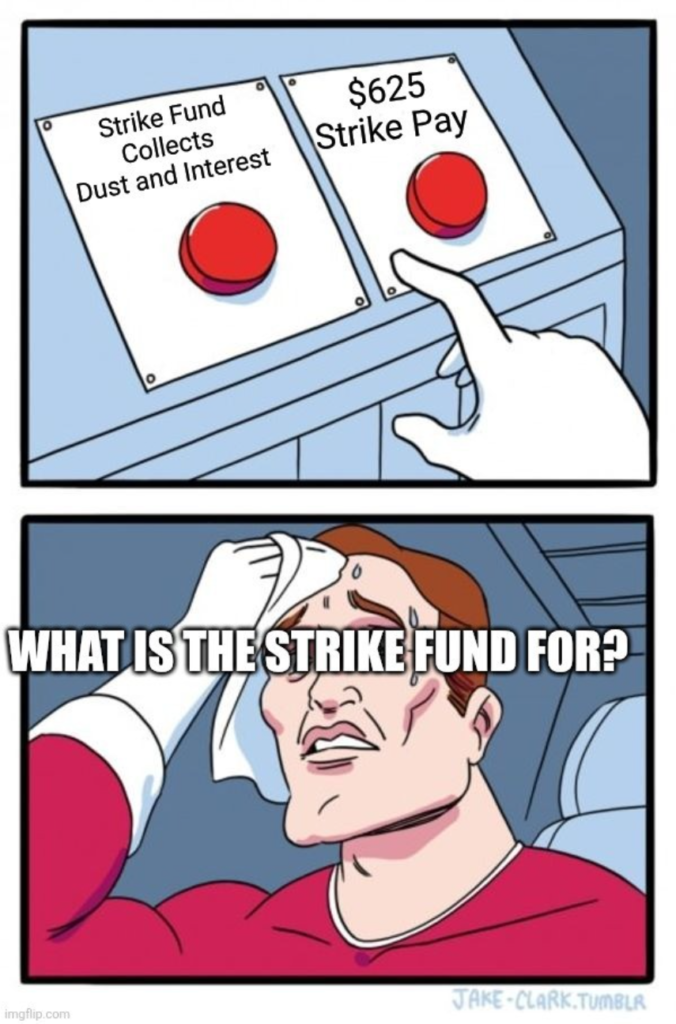
Is it fair to ask these members to sacrifice financially even as they have paid more of their dues into the strike fund with each raise? Payments for a fund that is supposed to support them when they need it the most. The mission of the Strike Fund is to provide financial stability at one of the most vulnerable times in a member’s career. Denying members this support while the fund collects dust and interest in not fulfilling its mission.
Increasing strike pay to $625 will help members maintain financial stability, support stronger morale during strikes, and let the company know that members will not be “starved” into a weak contract.
The video review of this article can be seen here:
Ask your Delegate to support increasing strike pay!